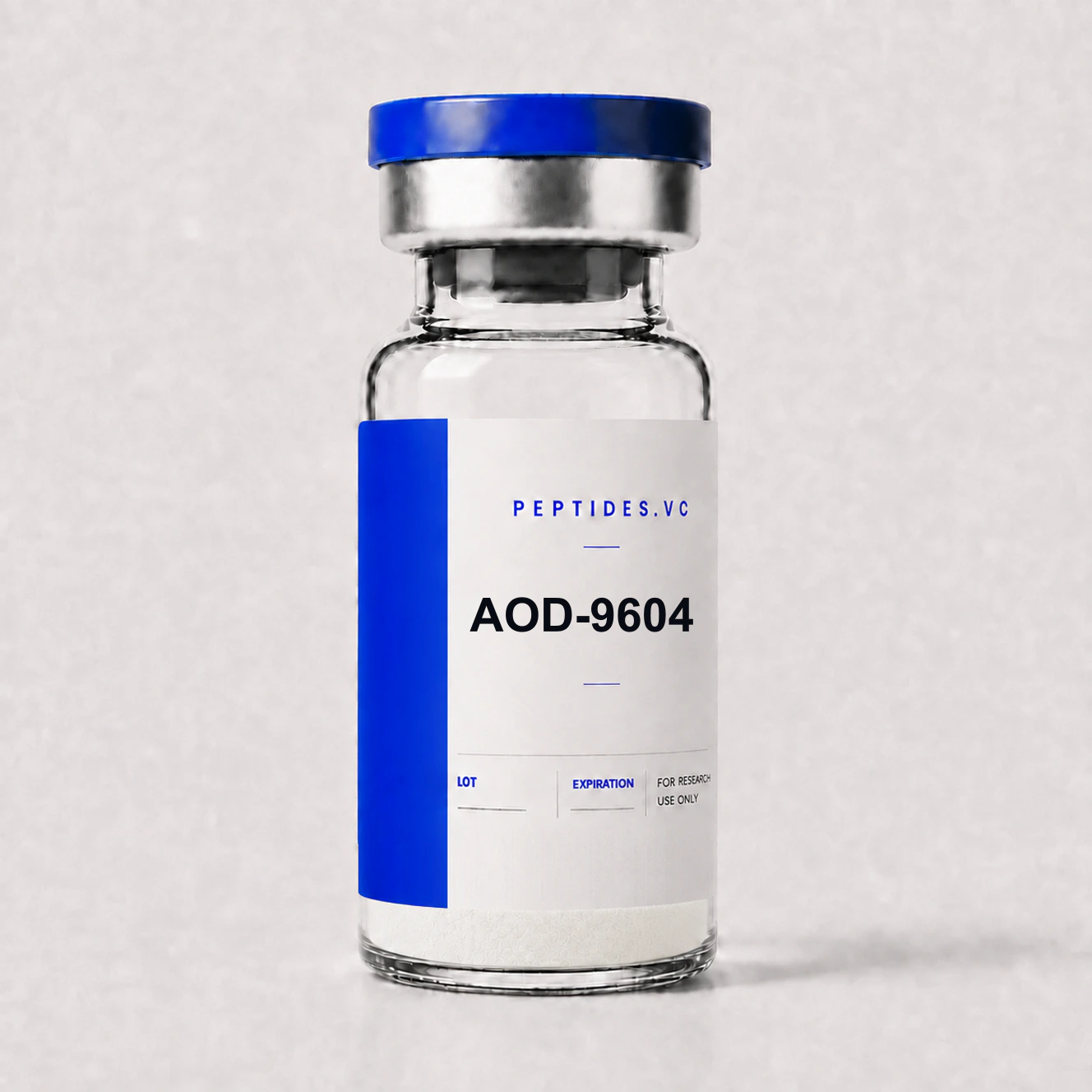
About the compound
hGH(177-191) with an additional N-terminal tyrosine — 16 residues, internal disulfide C7–C13. C₇₈H₁₂₃N₂₃O₂₃S₂, MW 1815.07 Da.
AOD9604 is HGH(177-191) extended by an N-terminal tyrosine: YLRIVQCRSVEGSCGF. The 16-residue peptide carries an internal disulfide between Cys7 and Cys13 (the two cysteines of the parent fragment). Empirical formula C₇₈H₁₂₃N₂₃O₂₃S₂; MW 1815.07 Da.
Reconstitution. For in-vitro laboratory handling, dissolve with bacteriostatic water (0.9% benzyl alcohol). Compound is hygroscopic — handle in low-humidity conditions and re-cap immediately.
Stability profile. Lyophilized: stable at room temperature for up to 30 days sealed; long-term storage at -20 °C recommended. Reconstituted material: stable at 2–8 °C for up to 14 days.
Selected primary literature.
- Heffernan M et al., 2001, Endocrinology 142(12):5182 — preclinical in-vitro lipolysis assay characterizing the AOD9604 sequence (chemistry-context observation).
What remains uncharacterized: concentration-response relationships in any specific in-vitro model system are not implied here. The literature cited above describes molecular-level observations only.
For research use only. Not for human or animal consumption.